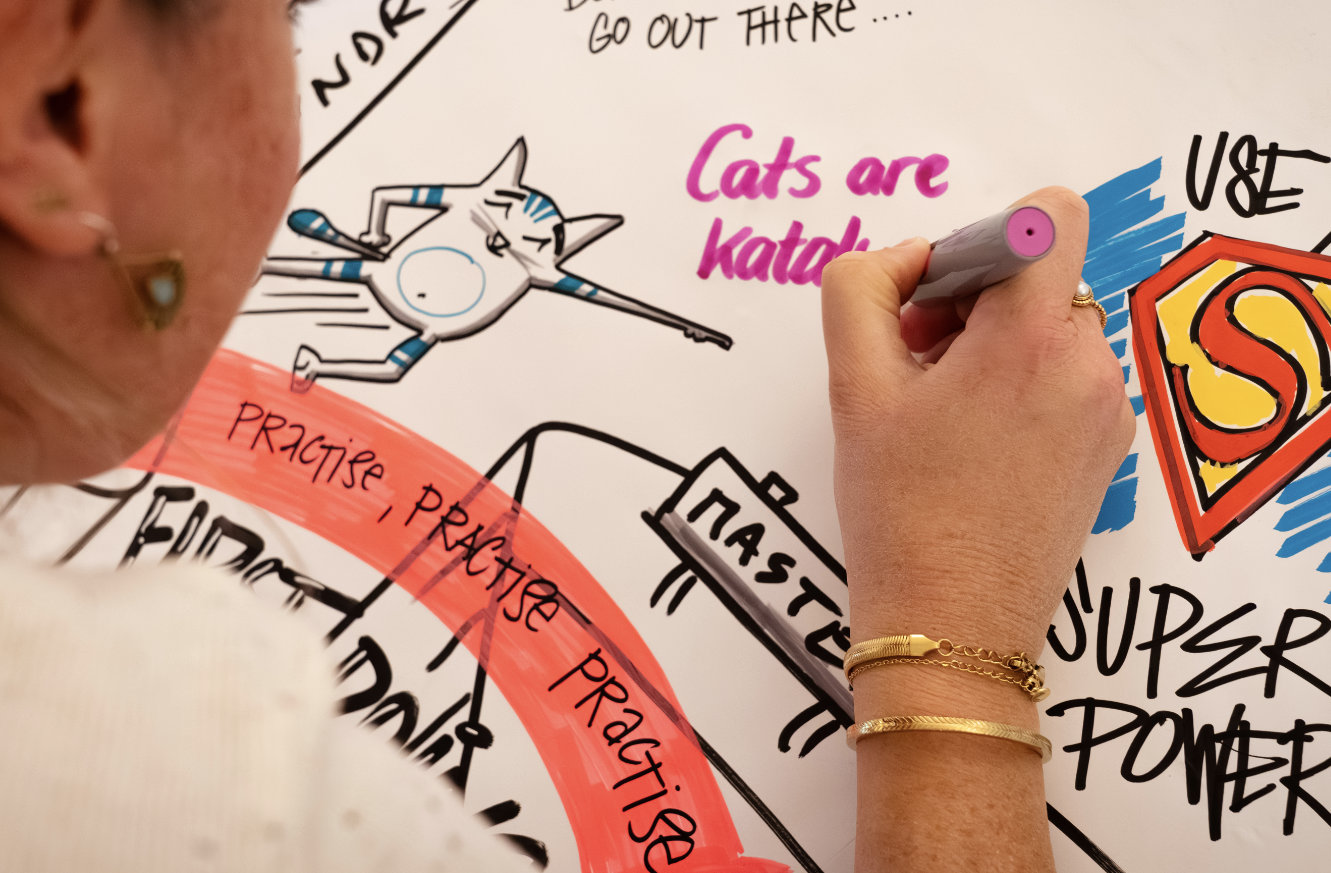
We went to Berlin to explore how to communicate change at work, but discovered that the walls we most need to dismantle were much closer to home…
For our first Visual Storytelling Creative Retreat in Berlin, we came to explore how drawing and visual storytelling could help people communicate and activate change in more compelling ways at work.
Activities? Check. Materials? Loads. Program? You bet.
We even had a wall! It was made of cardboard, and a lot less intimidating than the Berlin Wall. But it gave us somewhere to paste up the amazing, quirky and cheeky characters that our participants created during the retreat.
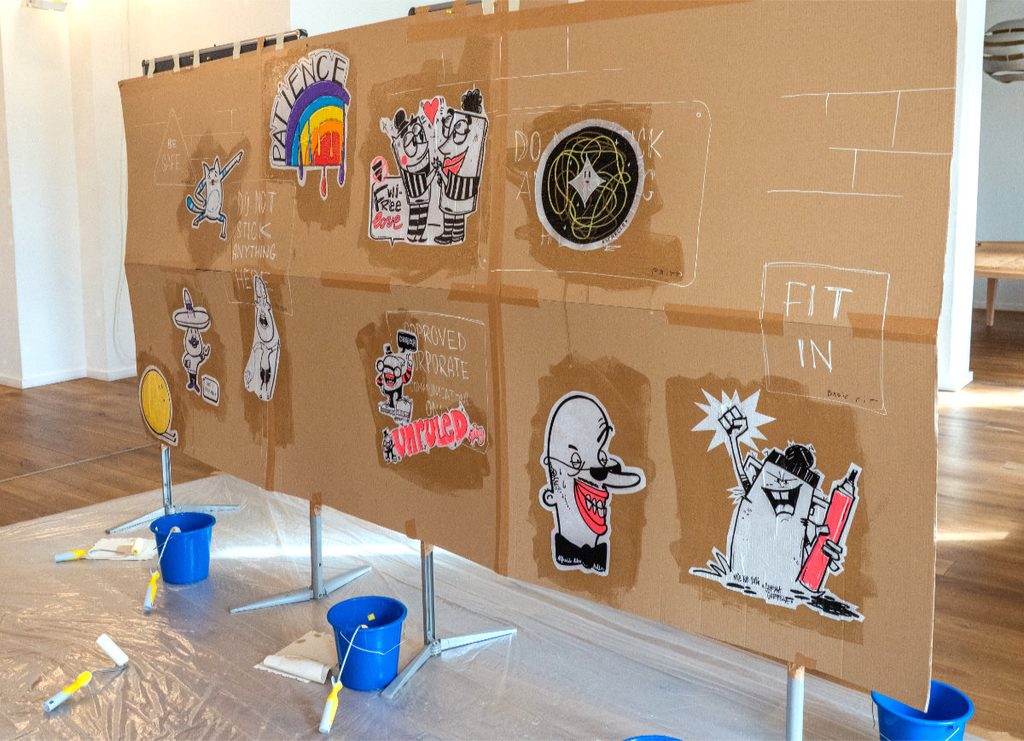
What we didn’t anticipate was that the most important walls in the room wouldn’t be made of concrete or cardboard.
What’s getting in your way?
This city knows a thing or two about walls: the ones built around us, and what’s possible when they finally come down. This was a perfect metaphor, to ask participants to identify obstacles from their professional lives. After all, this was a retreat about using visual storytelling to communicate and activate change at work. Right?
Right…?
Turns out, our instructions were too vague! And instead, nearly everyone chose something personal. Self-doubt. Impostor syndrome. The frustration of knowing new ways to try things, but not knowing what way to try. Or, the uncertainty of living in two worlds: doing “serious” full-time business work while wondering what it might mean to become a full-time artist. Not being able to see what was on the other side of that ‘wall’, and therefore not feeling ready to go through it.
Important stuff. Very very worthy of exploring. But it wasn’t what we expected they’d choose.
This was our first surprise.
It was also our first clue that the retreat wasn’t going to follow the tidy path we had plotted for it.
The program itself turned out to be a wall
Creative processes are messy. We all know this. In theory.
Then you put a bunch of people in a room, each with different experiences, expectations, creative practices and personal walls… and you get to experience that messiness for real.
At two points during the retreat, we had to rework the program. At one point we talked openly together as a group about how things were going, what people needed, and where they wanted the experience to go next.
We were super grateful that they did speak up. This was an unexpected act of rebellion, in a way. We listened. And we changed things up. And it was muuuuuch better!
And yes, changing a workshop in response to the people actually taking part is simply good facilitation, yeah? But it can be surprisingly difficult to loosen your grip on a carefully planned program, especially when you’ve invested months in creating it.
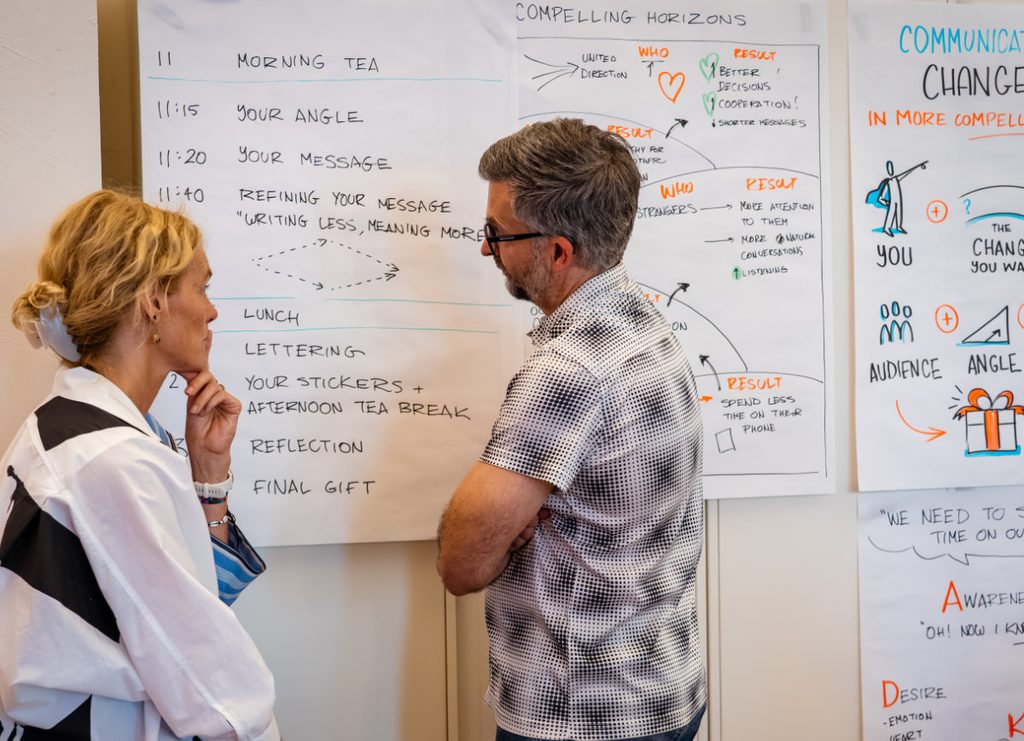
So, it turned out that the program itself – like the cardboard wall – was another wall we’d brought into the room, and busted our assumptions about what activities would get everybody to the other side.
Keep it simple, then build from there
Another lesson became really clear over the three days: start with something familiar, keep it simple, demonstrate it clearly, let everyone experience a small success, and build from there.
One of our local experts, Magdalena Wiegner, did this beautifully.
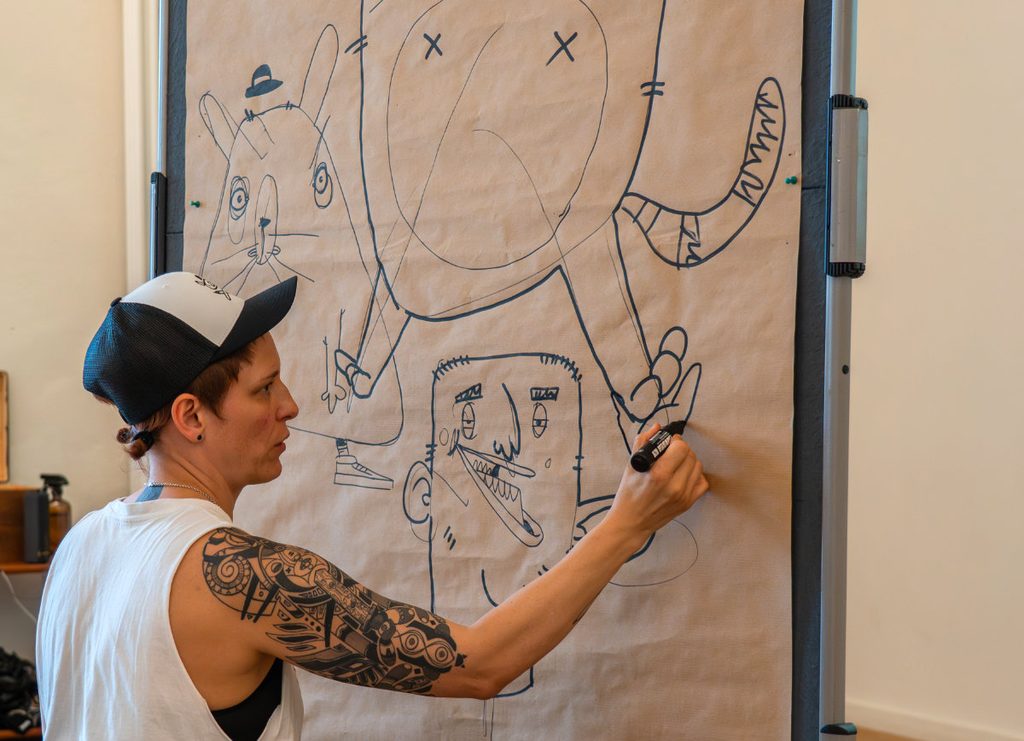
Mag guided everyone step-by-step through drawing their own cheeky characters, inspired by her own incredible street art. These characters were then pasted onto our not-so-real wall using very real wheat paste.
The results were brilliant!
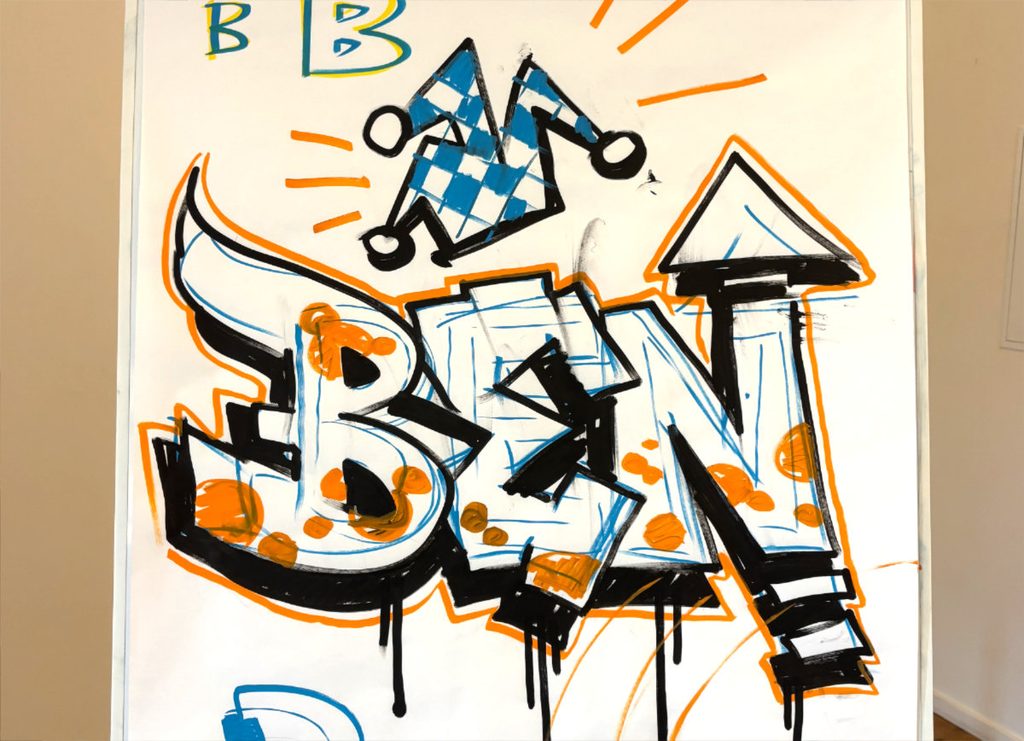
We then took a similar approach with a lettering activity. We began with something everyone knew super well: their own name. Then, step by step, each person turned it into a graffiti-style throw-up.
There’s something deeply satisfying about being shown just enough to get started, following along, and then looking down to discover that you’ve made something you didn’t know you could make. Huzzah!
Learning to read the city
Of course, Berlin wasn’t merely the backdrop to the retreat. It was one of our teachers, too.
In the expert hands of Ben (another local expert), we explored its streets and learned to “read” the visual communication all around us: murals, graffiti, throw-ups, ‘pieces, lettering, paste-ups, stickers and the countless creative interventions competing for attention on the city’s surfaces.
Street art doesn’t generally begin with a 48-slide stakeholder presentation. It has to communicate quickly. It has to make strong choices. It often has to work with limited colours, basic materials, crusty surfaces and very little time.
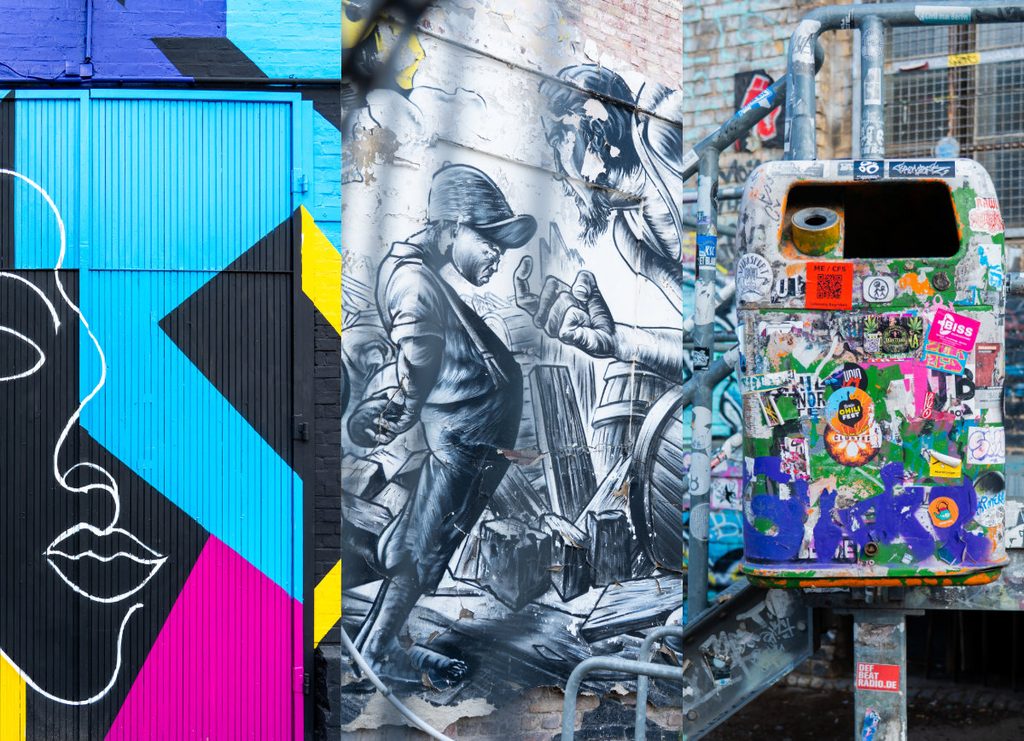
It can challenge, provoke, amuse or encourage you, before you’ve consciously decided to pay attention.
These are useful lessons for anyone trying to communicate change.
One participant, Else, created a large blue eye for her paste-up. She explained that it represented seeing all perspectives, and the invitation to bring to the surface the perspective still hidden underneath: “Because what you see isn’t always the whole story.”
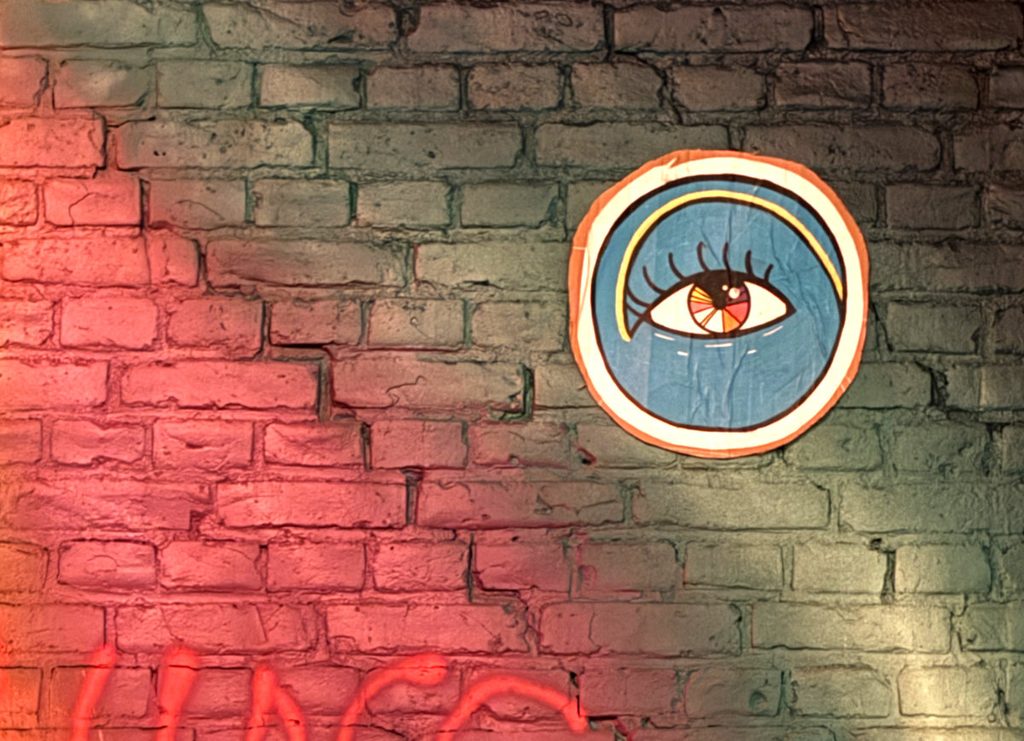
That idea now feels like a summary of the entire retreat.
We thought we could see the challenge. Then we looked underneath it.
Small stickers, longer stories
One of the simplest activities turned out to be one of the most meaningful.
Participants made hand-drawn stickers for one another, to encourage each other for the particular challenge each person was facing.
These were small objects. A few lines, colours and words on sticky paper. But they carried something bigger: I hear you. I can see what you’re trying to do. Here’s a little ‘Berlin bravery’ to take with you.
The stickers also refused to stay in the workshop. After the retreat, photos began appearing in our WhatsApp group, of some stickers being taken home and – ahem – placed in other spots, in other cities.
When your eyes light up
After returning home to Copenhagen, one participant said that when she described the retreat to other people, they said her eyes lit up. Her response was: “Yup, that’s it. You and Ben created an experience that ignites people.”
Axelle and I couldn’t have asked for a better description of what we hoped to create. Definitely not three perfectly controlled days, nor a foolproof formula for creativity.
A spark?
The Berlin retreat reminded us that creativity doesn’t always take the shortest path from problem to solution. Sometimes it needs to wander the streets, try something unfamiliar, make a mess, listen to other perspectives and discover that the real obstacle is not the one it expected to find.
Sometimes you need to stop staring at the wall and make something on it.
And sometimes, with the right people beside you, you begin to see what might be waiting on the other side.
Berlin, here we come – again!
We’ll be back in Berlin for the next Inking Abroad creative retreat, from 20-22 August 2027.
We’ll bring everything we learned from this first edition: more simplicity, more demonstration, more drawing, and more space for reflection and response. And oh yeah, plenty of street art, visual storytelling, creative courage, good company, and good food that made the first retreat so memorable.
And, given what happened last time, probably not entirely predictable!
An early-bird price is available now. Find out more and reserve your place for Berlin 2027!